Made by sawing
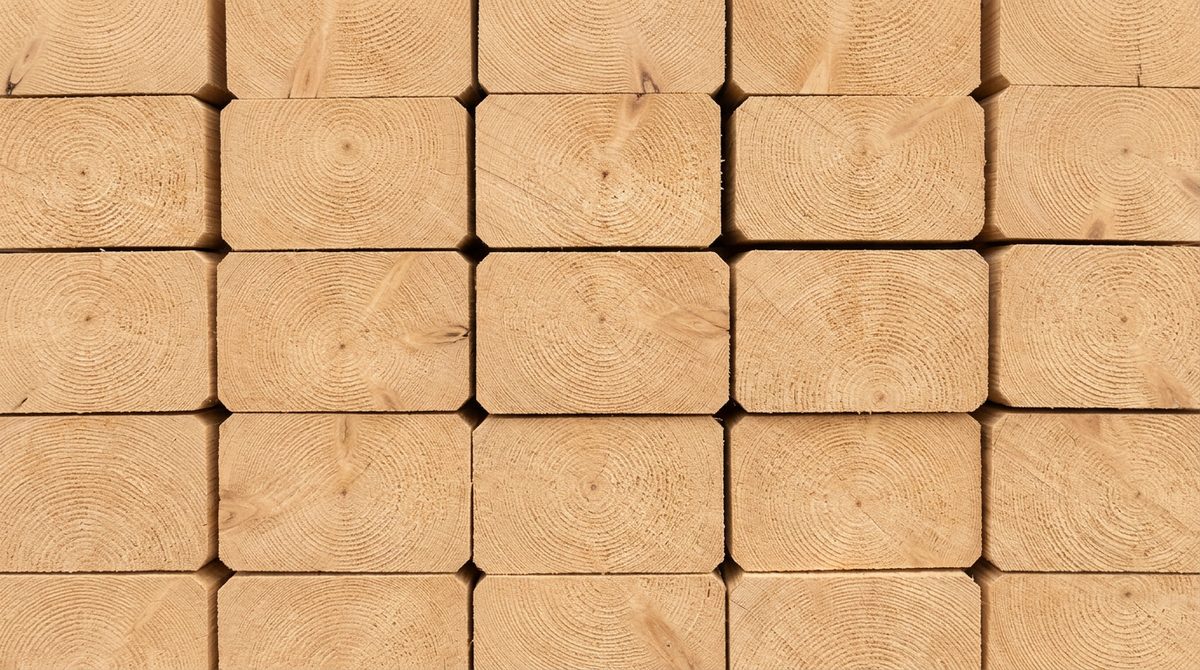
Mill Sawn Dimension Timber
A material sold as a number: two by four, two by eight, two by ten. Not a shape, not a grade of beauty, a number. That is a new idea in the nineteenth century and it changed how a wall is built more than any material in this catalogue.
- Which bed or works
- Standing white pine from the pine country north of the town, brought to mills that were the reason the town existed.
- How it was dressed
- Sawn to a nominal dimension, edged, sometimes planed on one face, then stacked and sold by that dimension.
- How it got here
- Hauled to the mills, then out by wagon locally and by rail beyond. It was the cheapest thing here while it lasted, and the first to run out.
Sold as a number
Before dimension lumber, a timber frame was made of pieces chosen and cut for particular positions, joined with mortises and pegs by somebody who understood the whole structure. Every piece was different and every piece mattered.
Dimension lumber replaces that with stock. A mill saws thousands of identical pieces to a standard cross section, and a builder buys them by the piece and nails them together in quantity. The knowledge moves out of the individual joint and into the pattern: studs at a regular spacing, doubled at openings, plates top and bottom, and the sheathing doing work that a braced frame used to do.
The result is that a wall becomes a repeated operation rather than a designed object. That is the single largest change in how ordinary buildings were put up in the period this catalogue covers, and it happened because a saw could be made to produce the same thing over and over.
What nominal means
The number on the piece is not the measurement of the piece, and this is a genuine trap for anybody reading old specifications. A piece called two by four was sawn roughly to that size green and then lost material to shrinkage and, later, to planing. The name stayed. The wood shrank.
So the number is a trade name, not a dimension. Later standardization narrowed the gap and formalized it, but the gap has never closed, and a piece pulled out of a wall built in this period will usually measure fuller than a piece bought now under the same name.
Why this material, in this city
Because it was here in a quantity that is hard to imagine now, and because the industry that cut it was the reason there was a town at all.
That fact is stated here once and then left alone. This catalogue is about material, not about an industry, and the story of the mills is told everywhere else. What matters for a wall is the consequence: for a few decades, framing was so cheap relative to everything else that it was used generously, and buildings from that window are framed heavier than the same building would be framed later.
And then it was gone
The pine did not last. The cut peaked and fell away, the mills closed or moved, and the material that had been effectively free became something bought from elsewhere at a price. Later framing in this city is a different product from a different place, and it is thinner, from smaller trees, with tighter grading.
A wall opened up is therefore datable in a rough way by what its studs are: wide, clear, heavy pieces of old growth pine belong to one period, and narrower, knottier, faster grown stock to another.
Where it shows
Everywhere, and almost nowhere visibly. It is the substance of the majority of buildings here and it is behind a skin in nearly all of them, which is why a catalogue of what a city is made of has to include a material that a walk past will never show. The only honest way to see it is when something is opened, and this publication takes that as a limit rather than as an invitation.
Made by sawing, one of five ways in the catalogue