Made by rolling
Sheet Metal, Delivered by Rail
The lightest material in this catalogue and the one that came the furthest, which is the same sentence twice. A sheet weighs almost nothing for the area it covers, so freight barely notices it, so it could be made anywhere and sold everywhere.
- Which bed or works
- None. Iron, and later steel, rolled to a gauge at a mill a long way from here and coated with zinc.
- How it was dressed
- Stamped in a die or bent on a brake into cornice, ceiling and siding patterns, then soldered, nailed and painted on site.
- How it got here
- By rail in crates, cheaply, because the ratio of covered area to weight is better than anything else here.
Rolled, not molded and not cut
Every other material in this catalogue is subtracted from something or shaped in a mold. This one is squeezed. A hot slab passes between rollers, over and over, getting thinner and longer each time, until it is a sheet measured by gauge rather than by thickness in a fraction.
A rolled sheet is anisotropic, which is a formal way of saying it has a grain: it bends more willingly across the rolling direction than along it. Anybody who has folded metal knows this in the hands. It matters here because everything made of sheet is made by bending, and the design of a pressed pattern has to respect which way the material wants to go.
What it was used for
Three things, mostly, and they are worth separating because they have nothing else in common.
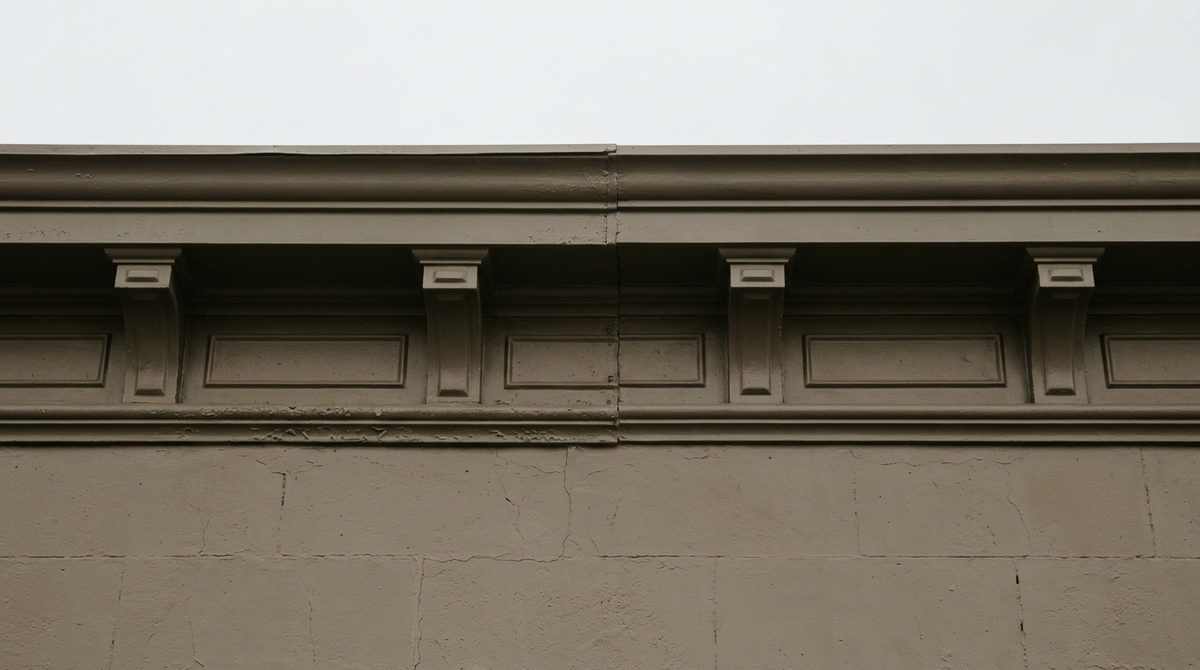
- Cornices. The bracketed, molded band at the top of a commercial front, stamped out of sheet in sections, assembled and painted to look like a heavy projecting mass of stone or wood. It weighs a small fraction of what it appears to weigh, which is why it could be hung off the top of a brick wall at all.
- Ceilings. Sheets stamped in repeating patterns, nailed up to furring inside a shop or a hall. Cheap, washable, and sold as a fire measure as much as a decorative one.
- Siding and roofing. Corrugated or pressed to imitate brick or shingle, nailed over a frame, and used where the money ran out or where nothing better was required.
Sold by the sheet and by the mail
This is a catalogue material in the most literal sense. Sheet metal goods were ordered from illustrated lists by pattern number, shipped in crates, and put up by a local tinner working from printed instructions. A cornice on a small town front might have been chosen from a page and installed by two people in a week.
That has a consequence a reader can check anywhere: the same pressed patterns appear in towns hundreds of miles apart, because they came off the same dies. Uniqueness is not what this material offers. Reach is.
What the weather does to it
Galvanizing is a sacrificial zinc coating, which protects steel by corroding in preference to it. It works well and it is finite. Once the zinc is spent at a scratch or a cut edge, the steel underneath goes, and it goes from the inside of a hollow assembly where nobody can see it.
So a pressed metal cornice fails in a characteristic way: sound paint, sound pattern, and then a section that has quietly lost its fixing. This catalogue notes that as a property of the material. It does not assess anybody's building, does not advise on repair, and names no trade.
Why it belongs in a catalogue of what a city is made of
Because it is the most visible material here and the least noticed one. The top edge of nearly every older commercial front in this city, the line against the sky, is very likely not masonry. It is a light sheet shell shaped to read as mass, bought from a page, and carried here for almost nothing.
Made by rolling, one of five ways in the catalogue