Made by cutting
The Soft Bed Under the Slope
A stone soft enough to cut with a hand saw the week it comes out of the ground, and hard enough two winters later to carry a wall. Both facts are the same fact, and together they decide where in a wall it is allowed to be.
- Which bed or works
- A Cambrian sandstone bed, reached where the ground falls away and the cover is thin enough to strip.
- How it was dressed
- Sawn green, then rubbed to a face. It works like a hard cheese wet and cures to something that rings under a hammer.
- How it got here
- A wagon haul, no more. That is why it sits in foundations, sills and lintels and hardly ever above the first story.
What the stone is
It is a sandstone of Cambrian age, which in plain terms means old, thickly bedded, and made almost entirely of quartz grains held together lightly. Under a hand lens it looks like what it is: sand that never quite finished becoming rock. The grains are rounded, the cement between them is sparse, and a corner rubbed with a thumb will powder.
That loose cement is the whole character of the material. A stone held together lightly can be cut cheaply, and a stone cut cheaply gets used by people who are not building a monument.
Why it was cut green
Freshly opened, the bed holds what the old surveys called quarry water, and while that water is still in it the stone is soft enough to be worked with tools no harder than a carpenter's. It can be sawn. It can be split square with a chisel and a mallet by one person. A face can be rubbed true with a block and sand instead of being pitched off with a hammer.
Then it dries, and the surface takes on a skin that is harder than the interior. The two states are what made it economical: soft when there was labor to be saved, hard when there was weather to be met.
The state geological survey's bulletin on building stone, published in the middle of the eighteen nineties, sets this behavior out for the sandstones of the western part of the state and maps the openings that were working at the time. The bulletin is worth reading for one habit alone: it lists what each bed could not do as plainly as what it could.
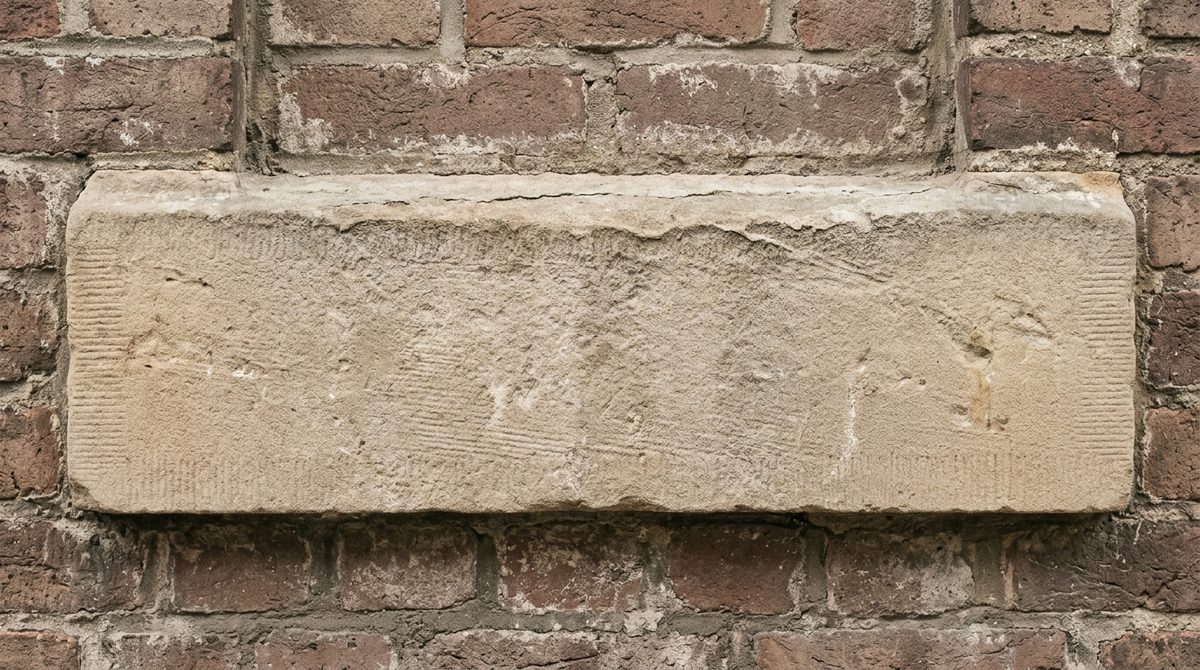
Where it shows
Low. Almost always low.
- Foundation courses, where the stone is under compression and mostly out of the weather
- Window sills, where a single piece spans an opening and takes water at its top edge
- Lintels over openings in stone or brick walls, in short spans only
- One belt course, a horizontal band set proud of the wall face to mark a floor level from outside
The pattern is not an aesthetic. A soft, thickly bedded stone laid on its natural bed and kept out of standing water lasts a long time. The same stone set upright, or used as a thin cap where water can sit and freeze in it, does not. Builders who used it every day knew that, and the surviving work is largely the work of people who respected it.
What the stone is not
It is not a facing stone in the sense a hard limestone or a granite is. It was not shipped anywhere. It carries no polish. And it is not the material of a whole front: a wall built entirely of it would need to be thicker than the money usually allowed, so it appears as parts rather than as a building.
What the insurance surveyors recorded
The fire insurance atlases of this city, drawn in the eighteen eighties and nineties and now in the public collections, color a wall by what it is made of: frame in yellow, brick in pink, stone in blue. Their interest was in whether a wall would carry fire from one property to the next, so they had no reason to flatter anybody's masonry and did not.
Blue on those sheets is scarce here, and where it appears it is usually the lowest part of a building whose upper walls are drawn pink. That is this entry in one image, made by somebody who had never heard of it.
Made by cutting, one of five ways in the catalogue